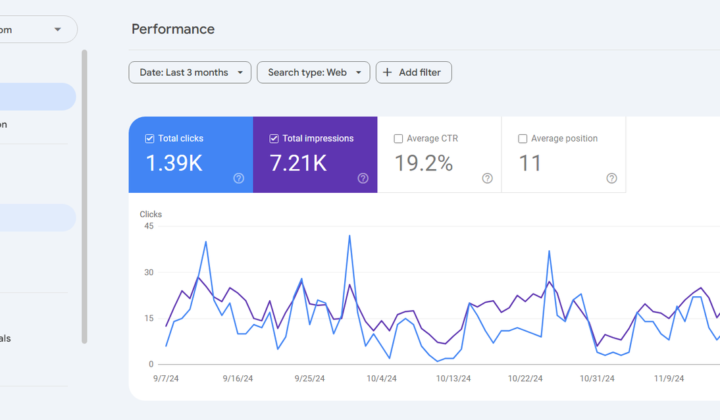
This project was for a website that relied almost entirely on visuals. The pictures did the work for visitors, but there was very little written content for search engines to index. Over the course of the work, its impressions went from 37 to 3.73K.
The challenge
The site relied on visuals while lacking content for indexing. That is the whole problem in one line, and it is a common one. People respond to images, but Google still leans heavily on text to understand what a page is about and which searches it should appear for. A page that is mostly a grid of pictures, with little or no description around them, gives it very little to match against a query, so the page is easily overlooked.
What I did
The work had three strands: technical adjustments, metadata organisation and keyword placement.
Technical adjustments
On an image-led site, technical work is about making sure the pages and images that matter can be found, loaded and indexed by search engines. In principle that covers how pages are crawled, how images load and how quickly the site responds. It is the same ground a technical SEO engagement covers.
Metadata organisation
Metadata is the text a visitor rarely notices but search engines read closely: page titles, descriptions and the alt text that describes each image. Organising it means each page and important image says clearly and consistently what it shows, rather than leaving the pictures to speak for themselves.
Keyword placement
Keyword placement means deciding which search each page should answer and putting that term where it counts, such as the title, the main heading and the text around the images. This is everyday on-page SEO. Placing a term well is not the same as repeating it, and on a visual site the text does not need to be long to give Google something to work with.
Results
- 37 to 3.73K impressions.
- A clear visibility lift in a site with image-heavy content.
Impressions count how often the site appeared in search results. They show that the site became visible; they are not clicks or enquiries, and I have not claimed either here.
What this shows
If your business sells through pictures, as photographers, interior designers, fitters showing finished jobs and shops with large product galleries often do, the images are not the problem. The problem is that search engines are given nothing else to go on. You do not need to replace your galleries with long articles. Give each important page enough text, sensible metadata and sound technical foundations, and it becomes something Google can understand and show. My glossary entry on image SEO covers the image side in more detail.
Every site starts from its own point, so the figures here will not carry over to yours. If your site is mostly images and you want to know what is holding it back, request a free SEO audit and I will tell you what I would fix first.